|
|
Hi Shopifreaks
Big week in e-commerce! Some weeks are inevitably more exciting than others in our industry when it comes to product releases and company updates, and this week is a fun one. It's a fairly comprehensive edition, even more so than usual, so let's dive right in.
In this week's edition I cover:
- Reddit's new AI shopping search
- TikTok backpedals on its seller-fulfilled shipping ban
- Perplexity joins "Team No Ads"
- Google Photoshoot can make your product images
- Amazon surpasses Walmart in revenue
- eBay is buying Depop from Etsy
- ChatGPT Ads are surfacing in the wild
- Google is showing more links in its AI results
- Amazon and Shopify are now 50% of US e-commerce sales
- AppLovin is building a social network
- Pinterest enters into "code red" mode
- Apple embraces video podcasts
All this and more in this week's 266th Edition of Shopifreaks. Thanks for subscribing and sharing! |
☁️ TaxCloud - Most U.S. businesses don't realize they can save thousands on sales tax. SST-eligible companies can file for free in 24 states. |
Stat of the Week
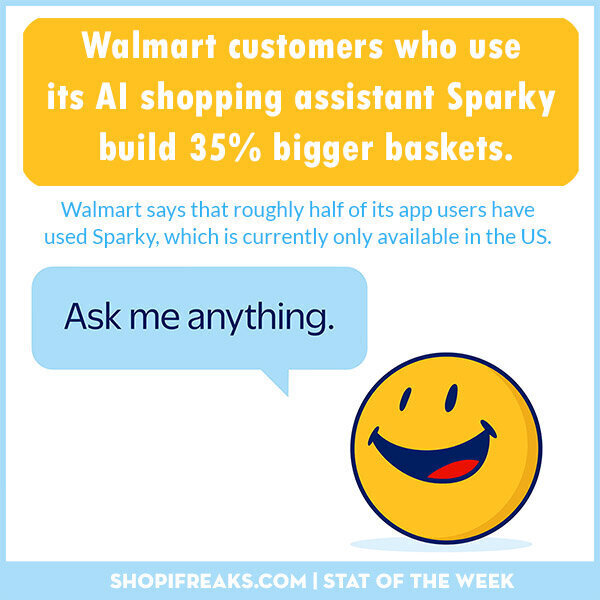
Walmart customers who use its AI shopping assistant, Sparky, build 35% bigger baskets, according to the company's newly appointed CEO John Furner. On the same earnings call, Walmart US President and CEO David Guggina shared that roughly half of Walmart's app users in the US have used Sparky. He said, "From an economic standpoint, better discovery and higher conversion translates into bigger baskets and greater frequency. … Sparky is helping customers find the things they need, they want and they love, and it's strengthening our digital unit economics as it scales." |
✨ Seguno - Practical apps exclusively for Shopify brands, from email marketing and popups to discounts and design tools, all made to work seamlessly together. |
1. Reddit is testing an AI search feature for shopping
Reddit is testing a new AI search tool that takes community recommendations and matches them with products that are fed into the platform from the product catalogs of their advertising partners.
The company wrote:
"For a small group of U.S.-based users, when relevant, search results will now include interactive product carousels with pricing, images, and direct where-to-buy links."
Here's how it works:
- A Redditor searches for something like, "best gaming chair to mask the smell of farts"
- At the bottom of search results, they will see a related product carousel that highlights items directly mentioned by users from conversations on related posts.
- Tapping on a product card allows the user to see more details about the product including where they can purchase it on select retailers.
As if there wasn't already enough incentive for brands to spam Reddit with fake "authentic" conversation about their products, now it's about to get a lot worse. To explain...
Reddit ranks very well on Google, and for years, companies have been manipulating the platform to surface their brands via posts that likely outrank their own websites for non-brand specific searches. For example, using one brand-controlled user account, they'd ask on the r/hiking subreddit, "What are the best waterproof hiking shoes for hiking in the rain?" Then from other company-owned accounts, they'd brigade the comments and upvotes with recommendations for their own brand, making it appear as if their hiking boots were the top choice by users in the subreddit.
And it worked! The post would get upvoted, eventually rank on Google when users searched for a similar query, and non-Redditors would see the recommendations for XYZ Hiking Boots Brand and search for the company.
I moderate several Shopify and e-commerce subreddits, and the tactic is pervasive on the platform. "What's the best app for blah blah?" "Oh you might like ABC App!" which of course happened to just launch yesterday, with both the question and the answer coming from brand new accounts with 1 Karma. It's an obvious tactic if you pay attention, but visitors from Google are likely viewing the post for 30 seconds and moving on, so the inauthenticity of the post engagements falls below their radar.
Fake engagement around brands has already been an issue that's plagued Reddit for many years, and now with AI-recommended products headed your way, the incentives are even higher. It's an issue that Reddit will need to pay extra attention to, but they likely won't because the legitimacy of information on their forum matters less than the revenue it derives from the advertising. So buyer beware! |
🐟 Go Fish Digital - Specializing in SEO, paid media, & social commerce, we blend AI-powered insights with sharp strategy, agile execution, and a team deeply invested in your results. |
2. TikTok changed its mind about banning seller-fulfilled shipping
In January, I reported that TikTok would soon require all US merchants to fulfill orders through its in-house logistics service, Fulfilled by TikTok, use Upgraded TikTok Shipping, where it controls the labels and carrier selection, or use its new Collections by TikTok, which is a door-to-door pickup service available in select US cities. Alternatively, sellers would be able to use specific approved fulfillment software, such as Aftership or ShipHero, as long as those systems fully integrated with TikTok's logistics API.
That news did not bode well for sellers, nor did the short timeline to make the transition, which took effect Feb 9th for new sellers and was set to begin Feb 25th for existing ones.
The changes impacted sellers who:
- Fulfilled items from Amazon FBA or Walmart WFS
- Shared inventory from one warehouse across multiple sales channels
- Did their own fulfillment from their garages
- Basically anyone who wasn't already using TikTok's fulfillment services!
The new requirements would've meant that sellers had to ship dedicated inventory to TikTok's warehouses to sell on the platform, even though they didn't know if it'd sell. Or on the flipside of the coin, preclude sellers from being able to realize peak sales when their products go viral if they didn't have enough inventory stored with TikTok.
The impact was so severe that many sellers, including enterprise brands, were considering opting-out of selling on TikTok Shop, which is the opposite of what TikTok wants.
Well, "good news everyone!" says Professor Farnsworth. TikTok has reversed course on its plan to end seller-fulfilled shipping in the US, and merchants are free to continue with their existing fulfillment setups.
The company wrote in an e-mail to sellers:
"We are writing to clarify the current status of Seller Shipping following our previous communication regarding potential updates. At this time, Seller Shipping remains unchanged, and previously shared deadlines are not going into effect. In the meantime, please continue operating as usual. We will provide further details."
Honestly, what were they thinking? Someone will likely get fired over that debacle.
Amazon FBA grew to become a dominant player in logistics by offering a better mousetrap for merchants, not by forcing it on them. It was a serious misstep by TikTok to even consider the idea, let alone bring it to light. Is this the kind of genius work we can expect moving forward from the new US team? If so, yikes! |
🔥 Partner News
Seguno expanded its Canva integration across its apps: Seguno Email Marketing and Shopify Connect for Canva. Merchants can now create, edit, and sync images between Canva and Seguno Email, cutting steps between creative production and campaign send. With Shopify Connect for Canva, merchants can access Shopify product images in Canva Email and Doc designs, edit variant visuals with product details attached, and generate collection links. The changes are designed to help users speed up their workflow between Canva and their Shopify store. |
🤖 Napster - Meet Napster Station: The first AI concierge built for noisy, chaotic, real-world spaces. It sees you. It hears you. It handles everything. |
3. Perplexity joins Anthropic in the anti-ad movement
Perplexity announced that it plans to double-down on its efforts to grow its subscriptions business and enterprise sales and move away from pursuing an ad-supported model. Back in 2024, I reported that the AI search company began experimenting with ads, but those efforts ultimately stalled.
An unnamed Perplexity executive told FT that "the challenge with ads is that a user would just start doubting everything... which is why we don't see it as a fruitful thing to focus on right now." Instead the company will focus on producing results that users are "willing to pay for," particularly targeting high-powered users like finance professionals, lawyers, doctors, and CEOs.
So instead of making an advertising play, Perplexity is betting that rich people use different search tools than the rest of us? They might want to revisit that thesis.
A few weeks ago I reported on the Anthropic Super Bowl ad that got Sam Altman all riled up. The commercial features a man asking ChatGPT, which is depicted by a middle-aged blonde therapist, for advice on how to talk to his mom. The woman starts by offering some decent advice like "start by listening" or "go on a nature walk." Then she suddenly pivots into an advertisement, recommending that he find emotional connection with other older women on a fictitious dating website called Golden Encounters. The commercial finishes by saying "Ads are coming to AI. But not to Claude."
The Anthropic ad seems to have drawn a line in the sand between AI companies with ads and AI companies without. Perplexity has since crossed sides, leaving OpenAI alone as the sole bad guy running ads (or at least that's how Anthropic is attempting to position them).
Google currently displays ads within AI Search and AI Overviews, but has not yet integrated advertising into its Gemini chatbot. Though I imagine that it's only a matter of time before they do, and I wouldn't expect anything different from the king of online advertising. |
⭐ doola - LLC Formation, Bookkeeping, Business Taxes, and E-Commerce Analytics—one platform, one point of contact, zero stress. |
4. Google launches "Photoshoot" feature to create professional product images using Nano Banana
Google Labs introduced a free tool called Photoshoot in its Pomelli platform, enabling businesses to create professional product images using Gemini Nano Banana. If you're unfamiliar, Pomelli is an AI marketing tool that Google launched in Oct 2025 to help SMBs generate marketing campaigns. Now it'll help do some of the heavy lifting in regards to creating the product images for those campaigns.
Here's how it works (quoted directly from Google's blog post):
- Pick a product: Start with any picture, and don't worry about polish — we'll take care of it
- Choose a template: Select from professionally curated templates like studio or lifestyle, or let Pomelli suggest some for you
- Generate: We automatically apply your business' aesthetics to generate professional-looking images that feel on brand
- Refine: Edit and adjust your images with finishing touches
I tried it out, and I've got to say... swing and a hit for Google!
It works better than many paid tools I've experimented with in the past. Though like any AI image generation tool on the market right now, it's not quite at a point where you're going to want to fire your photographer, but it certainly can help complement their work.
During the past couple of years, I've been pitched countless apps or SaaS products that tap into LLMs from major AI firms and simply add advanced prompting and a user interface on top. I knew it was just a matter of time before the companies themselves began packaging their models into products that target specific use cases -- and Photoshoot is a great example of that in action.
Technically Nano Banana is doing most of the heavy lifting in regards to creative generation, but the Photoshoot product caters the output to a specific use case for merchants. This is the "SaaS killer" style application in action that developers express concern about.
Have you tried Photoshoot? How'd it work for your images? Hit reply and let me know. |
🌤️ Cloudways - Simple, scalable managed hosting with AI-powered server diagnostics and automated troubleshooting for agencies, developers and businesses. |
5. Amazon is now the world's biggest retailer by sales
Well, it finally happened. Amazon officially dethroned Walmart as the world's biggest global company by revenue, taking the spot away from the retailer, which had held the #1 position for the past 13 years, and 21 of the past 24 years.
Wait, time out for a second. Who took the spot from Walmart for 3 out of the past 24 years?
ExxonMobil held the #1 revenue spot from 2009-2011, during a period when high oil prices temporarily pushed its revenue above Walmart's, until oil prices normalized a few years later.
Let's dive into the Amazon vs Walmart numbers:
- Walmart reported a record $713.2B in fiscal-year revenue, which ended on Jan 31st, up 4.7% from the prior year.
- Amazon slightly edged past it for the first time with $716.9B for fiscal-year 2025.
- Of Amazon's reported revenue, retail sales (online and brick-and-mortar) totaled around $493.6B, while AWS reached $128.7B, and subscriptions and advertising hit a collective $118.6B.
- Whereas almost the entirety of Walmart's revenue was retail-based. So without AWS in the picture, Walmart is still technically a bigger retailer, but the Fortune 1 position looks at total revenue.
- One other detail of interest is that Walmart reached e-commerce profitability for the first time with $150B in online sales, which is still only around one-third of what Amazon sold online, but it's catching up!
Strangely enough, Amazon and Walmart may compete neck and neck for the top revenue spot, but neither holds the top position as the world's most valuable company by market cap. That award goes to Nvidia, with a market cap of $4.67T, more than double Amazon's and more than four times larger than Walmart's.
For comparison, Nvidia revenue surpassed $130B in 2025, less than one-fifth of Amazon or Walmart's revenue, yet crushes either company in market cap -- which doesn't make sense to me given that people will still be grocery shopping and buying household items in 20 years, while most of these AI data centers will become Halloween Superstores. |
💡 Ideas Focused - Need help growing your e-commerce store or app? Get a free consultation from Paul Drecksler -- the creator of this newsletter! |
6. eBay is buying Depop from Etsy for $1.2B
eBay announced a definitive agreement to purchase Depop from Etsy for $1.2B in an all-cash deal. Etsy had acquired Depop, which was previously an independently owned fashion resale marketplace, in June 2021 for $1.625B. Depop will continue operating under its own brand after the deal closes in Q2 2026, pending regulatory approval.
Wow, a $425M loss? What did Etsy do to that poor company in the past 5 years?
Nothing worse than it did to itself...
Depop losing 25% market value in 5 years under Etsy's ownership means it actually fared better than Etsy itself during that same timeframe, during which Etsy lost 72% of its market value. The ETSY stock was trading as high as $184 per share in June 2021 when the company acquired Depop, and now hovers around $52 per share.
Maybe instead of selling Depop, they should've sold Etsy. LOL.
Why did eBay acquire Depop, and why did Etsy sell it?
eBay says the deal will help it reach Gen Z and Millennial consumers, as well as expand its fashion category, where it already does over $10B in sales each year. Depop generated about $1B in GMV in 2025, has 7M active buyers with nearly 90% under age 34.
As for Etsy, the company says it wants to refocus on driving growth for its core marketplace, which desperately needs attention. The sale marks the third and final shedding of brands that former CEO Josh Silverman had acquired, including Reverb, which Etsy bought in 2019 for $275M and sold in 2023 for $105M, and Elo7, which Etsy bought in 2021 for $217M and sold in 2023 for an astonishing $19M.
Etsy has a steep climb ahead to get back to its glory days. The once-artisanal marketplace has lost both consumer and seller trust in recent years while chasing short term gains and expanding beyond its original mission of supporting sellers of handmade goods. I wish them the best of luck under their new leadership.
What are your thoughts on Etsy's future? Hit reply to this e-mail or join the conversation on LinkedIn. |
7. ChatGPT Ads are slowly appearing for more users
ChatGPT ads are starting to surface in the wild, including ads from Expedia that were spotted by Ashley Fletcher from Adthena. Asking ChatGPT, "What's the best way to book a weekend away?" resulted in an organic answer, followed by two ads for Expedia at the bottom of the response.
Ashley noted:
"Contrary to early predictions that ads would only appear after a back-and-forth dialogue, these triggered immediately on the first prompt response. Notably, the UI features a prominent brand favicon and a 'Sponsored' label, slightly different to OpenAI's original concepts."
I couldn't help but notice how terribly written the two side-by-side ads were.
The first said: "Last Minute Weekend Getaways. Find & Compare Package Deals and You Can Save Big! Browse Last Minute..."
The second said: "Romantic Trips for Couples. Compare Package Deals and You Can Save Big! Browse Romantic Trips for Couples o..."
Did ChatGPT write those ads? I think it must've because they've got that classic ChatGPT-tone, recognizable by any marketer who's ever asked for its help writing ads.
Was "You Can Save Big!" the only benefit-focused verbiage it could think of? That sounds like it was written by a 1980s TV ad writer.
Not to mention it used the verbiage "Last Minute" twice in the first ad and "Romantic Trips for Couples" twice in the second ad. Talk about a waste of space!
On that note, why did the ads get cut off? If ChatGPT is writing its own ads, then why wouldn't it write an ad that fits the allotted character limit? Or even worse, if humans at OpenAI or Expedia wrote those ads, why would they write such horrible ones that got cut off?
Lastly, is that the best it could do in regards to personalization? Generic sounding ads talking about "last minute deals" and "save big" to an affluent user who made no such mention of traveling last minute or searching for budget options?
This is sloppy work, especially by an AI firm asking for $200k commitments and supposedly working with advertisers directly as part of its beta group. These ads look like they were written by an intern who used ChatGPT!
It can only get better from here, I guess. |
8. Google AI results will display links more prominently
Google announced that it is updating its AI search results to display source links more prominently on both desktop and mobile platforms and introducing a new interface that reveals descriptions and images within pop-up menus when users hover over citations.
Robby Stein, Product VP for Google Search, wrote on X:
"In AI Overviews and AI Mode, groups of links will automatically appear in a pop-up as you hover over them on desktop, so you can jump right into a website to learn more. And we'll show more descriptive and prominent link icons within the response across both desktop and mobile. Our testing shows this new UI is more engaging, making it easier to get to great content across the web."
The changes were also likely made to appease scrutiny from publishers and regulators who claim that Google's AI Mode is resulting in less traffic to their websites. In December 2025, the EU actually began investigating Google for breaching its competition rules by using content from web publishers for its AI search tools, while failing to provide "appropriate compensation" or the ability to refuse use of their content.
Historically publishers, myself included, have catered to Google's precarious whims because the juice was worth the squeeze in regards to the traffic it could generate. However if that traffic dries up because no-one's visiting the actual websites that publish the information, then publishers might find less incentive to allow their content to get ingested by Google. And that could eventually be a problem for Google.
However that said, making links more prominent in AI results feels like giving an inch to take a mile. Google Search used to bring you 10,000 visitors a day and now that's dried up to 1,000? Here's 2,000 instead (at least for the time being). Enjoy your scraps, publishers! |
9. Other e-commerce news of interest
Amazon and Shopify together now account for approximately 50% of US e-commerce sales, according to Marketplace Pulse estimates. Amazon generated roughly $440B in US sales in 2025, representing a 35.7% share, while Shopify claimed a 14% share in a recent earnings call, for a combined 49.7%. This was only the second time that Shopify has ever publicly reported a US market share figure, and while 14% is certainly an impressive number, Marketplace Pulse's headline reminded me of that scene from Silicon Valley where Erlich Bachman is talking to reporters about Gavin Belson and says that "between the two of us, we are worth about 25 billion dollars."
AppLovin is preparing to build a social networking platform, following its failed bid to buy TikTok last year. The plans were outlined by a senior executive at the company in a recent Chinese-language podcast and detailed in a job posting seeking someone to "architect the digital backbone of our next-generation social platform." Unlike Facebook, Instagram, and other social networks that built up an audience first before monetizing it with advertising, AppLovin already has the ad placement system, but predominantly delivers those ads into other companies' apps, after selling its portfolio of games last year. Now it needs its own digital real estate again to spam its ads on.
Pinterest has been initiating a series of "code red" projects aimed at boosting key metrics like user and revenue growth and advertiser ROAS, according to two employees who spoke to The Information. The company has been pitching itself to investors and advertisers as a search app, as opposed to a social media app, and has been publicly sharing the progress it's made on increasing commercial searches, which it considers to be searches with shopping intent. Internally, Pinterest has also been focusing its sales team on selling more ads that trigger clicks and purchases, versus brand awareness ads, and devoting more engineering resources to filtering out AI content, which their users find off-putting.
Walmart reported its first full year of e-commerce profitability, thanks in part to the growth of high-income shoppers, who Walmart said are attracted to its combination of low prices and increasing convenience. The retailer saw online sales jump nearly 25% to top $150B in its most recent fiscal year, even as Amazon dethroned it as the world's largest company by revenue. Executives in-part credited the "Sparky" AI assistant for increasing transaction totals, as well as the company's growing online grocery business and expansion of its fashion assortment.
Bath & Body Works launched an authorized storefront on Amazon for the first time to offer some of its best-selling soaps, fragrances, and candles with Prime shipping eligibility. The retailer is aiming to leverage Amazon's logistics network while retaining control over its inventory and pricing strategies. CEO Daniel Heaf told CNBC that the move allow the company "to put ourselves directly in the path of the consumer. It's about meeting them where they already shop." Prior to the official storefront launch, Bath & Body Works products were sold on Amazon through third-party resellers, but now Heaf says the company aims to reclaim its brand story and sales on the marketplace.
Etsy is showing some items with a single shipping-inclusive price in search and shop pages in the UK, with a higher price display in search and the actual item price plus shipping breakdown on the item details page. Etsy confirmed to e-commerce consultant Cindy Baldassi that the change in the UK is due to the Digital Markets, Competition and Consumers Act, which requires all fees including shipping and taxes to be displayed whenever there is an "invitation to purchase." Sellers who offer a single flat rate shipping option for all items purchased are concerned that all of their items are displaying a shipping-inclusive price, leading buyers to believe that they'll end up paying shipping for each individual item ordered. As usual, the company provided no warning and little transparency about the change to sellers.
TikTok rolled out new February updates for TikTok Shop, including automated creator sample approvals, "Creator Picks" for affiliate discovery, and auto-generated monthly affiliate commission receipts. Sellers can now set criteria for auto-approving product samples, batch download commission summaries, and use auto-posted LIVE highlights to extend reach. TikTok also introduced bulk product editing and category template tools for Shopify sellers to speed up large catalog management.
Apple is introducing a new integrated video podcast experience to Apple Podcasts this Spring to bring the platform more inline with competitors like Spotify, YouTube, and Netflix, which have all leaned into video podcasting in recent years. Within the Apple Podcasts app, listeners will be able to switch seamlessly between watching and listening to shows from the same feed, as well as use picture-in-picture mode and download video episodes for offline viewing. The new format also introduces dynamic video ad insertion, enabling creators on participating hosting providers and ad networks to insert video ads into episodes.
In other Apple video news... Apple Music and TikTok are beta testing new capabilities that allow users to play full songs directly within the video app, based on Apple's MusicKit framework, which allows developers to integrate Apple Music into their own applications. The companies are also developing a "Listening Party" feature that enables fans to stream music together in a community environment. The idea is to make it easier for TikTok users to discover new music and immediately start listening to that music without leaving the TikTok app. TikTok should also integrate with Netflix and other video streaming platforms while they're at it. Have you ever watched a TikTok clip from a movie or show that you wanted to watch or add to your playlist? That should be a one click experience.
Automattic launched an AI Assistant for WordPress.com sites on Business and Commerce plans that integrates directly into the block editor, Media Library, and block notes, allowing users to adjust layouts, rewrite or translate content, generate images using Nano Banana models, and fact-check content without leaving the editor. The assistant understands a site's existing content and structure, enabling it to modify blocks, add new sections or pages, and update styles in context rather than generating isolated outputs. It can be enabled in site settings, works best with block themes, and is automatically activated for sites built with WordPress.com's AI website builder. As for WordPress.org installs, sorry, but WPEngine users can't have it!
DoorDash CEO Tony Xu said on a recent earnings call that the company has something shoppers want that Amazon doesn't have -- choice. He said that few customers complete all their grocery shopping at a single chain, often stopping at multiple stores each week to find specific fresh groceries like produce, meat, and seafood. Whereas Amazon only has Whole Foods and Amazon Marketplace to pull items from, DoorDash has partnered with major grocery chains like Kroger, as well as regional chains across the country. All I can say about that is, give Amazon time. They'll have "choice" soon enough when it comes to groceries.
TikToker Khaby Lame's $975M deal to sell his social media and e-commerce business to Rich Sparkle Holdings is looking shaky, as the stock price of the company he's seeking a merger with has fallen from a peak of over $180 to $11 per share since the start of 2026. Good lord, WTF happened? Check out the stock's YTD chart! The deal was that in return for Lame's IP, his company would get 75M new shares in Rich Sparkle valued at $13 each, assuming someone actually buys those shares so he can cash out. But if the stock keeps tanking, so might the deal.
Amazon Web Services engineers reportedly allowed the company's internal AI coding agent, Kiro, to make production changes that contributed to at least two service outages, including a 13-hour disruption in December, according to the Financial Times. The tool had operator-level permissions and changes were finalized without second-person approval, bypassing normal safeguards. Amazon disputed the FT report, claiming that the disruption to its Cost Explorer service in one mainland China region was caused by a misconfigured access role, not an AI tool failure linked to Kiro. Whether true or not, it's funny how defensive big tech companies are about their AI. If only they treated their employees with the same reverence.
Whatnot announced its first ever seller conference to be held in Austin Texas this April. The one day in-person event will feature presentations on sourcing smarter, building high-converting live shows, increasing buyer retention, and scaling operations. Do you think they'll live stream it? Attendees will also be able to watch presentations from top sellers sharing strategies behind their success and participate in hands-on workshops that dive deeper into certain topics.
ByteDance launched Seedance 2.0 earlier this month, a text-to-video AI model capable of generating high-quality cinematic clips from prompts, and within days, Disney, Warner Bros., Netflix, Paramount, Sony and the Motion Picture Association sent cease-and-desist letters, alleging the tool enabled unauthorized use of copyrighted characters and actor likenesses. The most famous example of infringement was the 15-second AI-generated clip of Brad Pitt and Tom Cruise fighting on a rooftop, created using Seedance 2.0. Disney's legal notice alleged that ByteDance had effective pre-packaged Seedance with a pirated library of copyrighted characters, portraying them as if they were "public-domain clip art." ByteDance responded by promising to strengthen its copyright safeguards and content filters.
Amazon shut down its Blue Jay robotic system just months after its unveiling due to high costs and technical complexities. Blue Jay featured multiple robotic arms capable of reaching and lifting several items at once and leveraged AI to accelerate training and deployment, but ultimately the project's cost, manufacturing complexity, and implementation challenges resulted in Amazon putting it on pause. At least that's what Amazon said. Maybe the robots became sentient and tried to form a union. Amazon is now shifting its strategy toward "Orbital," a modular warehouse architecture designed for smaller facilities and grocery handling.
Klarna is recruiting its own customers to serve as freelance customer support agents for the company. CEO Sebastian Siemiatkowski said, "These are our most passionate customers. They love our product, they love how it works. They know Klarna in and out. And now they earn extra money by actually working on our customer service." In 2023, Klarna tried replacing most of its customer support workers with AI, which turned out to be a terrible idea because AI sucks. Now they're backpedaling on the decision and attempting to embrace the "human connection" again.
Sezzle, the Minneapolis-based BNPL firm, launched Sezzle Mobile, an unlimited mobile phone plan starting at $29.99/month that runs on the AT&T network, becoming the latest company to hop on the MVNO trend. Why would they do this? Because Klarna and OnePay did it last year? This is such a silly monkey-see, monkey-do side quest for Sezzle, and for all the other fintechs launching wireless networks. Just because you can, doesn't mean you should. I mean seriously, what's next for Sezzle, a stablecoin?
In lawsuits this week...
- Texas Attorney General Ken Paxton is suing Temu for allegedly functioning as "Chinese Communist spyware" disguised as a discount marketplace, accusing the company of using deceptive marketing to harvest user data and route it to servers accessible by the Chinese government. So what's the plan, have Oracle buy it? This is Paxton's fourth lawsuit in three days against Chinese communities, with the others including TP-Link, Anzu Robotics, and Lorex.
- Former NPR host David Greene is suing Google over allegedly stealing his voice for its AI-generated podcasts. Google denied the accusations and said that the voice is based on a paid professional actor, but a forensic analysis indicated a high probability that the model was trained on Greene's work.
- The Washington Supreme Court ruled that Amazon must face lawsuits brought by families with relatives who committed suicide by consuming sodium nitrite they bought on its marketplace, rejecting a lower court's ruling that families could not pursue negligence claims under a state product liability law.
- SerpApi asked a California court to dismiss Google's claims that it bypassed digital locks to gather copyrighted content in Google Search results. The company wrote, "Google's entire business began with a web crawler that visited every publicly accessible page on the internet, copied the content, indexed it, and served it back to users. It did this without distinguishing between copyrighted and non-copyrighted material, and it did this without asking permission. Now Google is in federal court claiming that our scraping is illegal." Touché!
- Cameo secured a preliminary injunction against OpenAI after a California judge ruled that OpenAI's Sora video tool cannot use the term "Cameo" for a feature that lets users insert likenesses into generated videos. OpenAI said it disputes the claim that the word "cameo" can be exclusively owned and plans to continue defending the case. If OpenAI is successful, I look forward to an open source AI company launching a model called "Open AI."
In corporate shakeups this week...
- OpenAI hired Charles Porch, Instagram's former head of partnerships, to repair its strained relationship with the entertainment industry. Porch is planning a "listening tour" to address the concerns of filmmakers and actors who have criticized the company's Sora video-generation technology as "horrifying" and destructive.
- Polymarket is hiring Mandarin-speaking staff and listing bets related to the Lunar New Year to target the Chinese market, even though its platform is restricted in the country. Apparently enough Chinese users access Polymarket via VPNs that Polymarket plans to develop a Chinese-language interface for its site and monitor search trends in the country to add more culturally relevant topics for bets. Can I bet on Polymarket that this won't end well?
- Roku appointed Patrick Harris, who previously held senior positions at Snap and Meta, as its SVP of Global Media Revenue to oversee ad revenue growth and performance efforts, working with senior execs across advertising, product, engineering, marketing, and measurement.
Google is testing a new "limited view" in Google Maps that restricts access to certain information such as reviews, photos, accommodation listings, and places of interest on the map unless the user is logged in. Google has not formally announced the test, but reports from 9to5Google indicate the difference between signed-in and signed-out experiences is significant, effectively making account login a requirement for access to much of the platform's crowd-sourced data. My guess is that this has to do more with blocking AI scrapers from accessing its repository of data than it does login-gating content from users. It's not as if Google doesn't know who you are regardless of whether you're logged in or not!
Airbnb is expanding its "Reserve Now, Pay Later" feature globally, which lets users reserve bookings without immediate payment and instead get charged closer to their check-in date. The company launched the feature in the US last year for domestic travel and says that since launch, the feature saw 70% adoption for eligible bookings and helped grow nights booked in the quarter. It makes sense that the feature has been popular with travelers. It's something that Booking.com and other platforms have offered for years.
Chinese manufacturers are advertising military-grade anti-drone weapons on TikTok using the style of lifestyle influencers selling cheap consumer goods. The videos showcase signal jammers and spoofing devices capable of disrupting GPS navigation, targeting Russian and Ukrainian viewers. For example, one woman wearing pink pants and a black satin blazer speaks into the camera, "I am from the factory of anti-UAV equipment in China. The equipment can be placed indoors, outdoors, and in the car. Works 24 hours a day." Although I don't imagine they get many complaints when their devices don't work.
A federal grand jury indicted three Silicon Valley engineers, including two former Google employees, for conspiring to steal trade secrets related to mobile processor security and cryptography and sell them to Iran. Prosecutors allege the defendants exfiltrated confidential files to personal devices, third-party platforms, and work devices tied to other employers, and later attempted to conceal their actions through false affidavits and destruction of evidence. If convicted, each faces up to 10 years per trade secret count and up to 20 years for obstruction. Yikes, did Silicon Valley engineers really need the money that badly? They could've just launched an AI startup like everyone else.
🏆 This week's most ridiculous story… Google's AI Overviews are reportedly displaying fake customer service phone numbers that are directing users to call scammers, who then try to take payment information or other sensitive details from the caller. The phone numbers are scraped from illegitimate websites owned by the scammers and subsequently served to users as verified information. Wow, we've come a long way with AI. Remember when scammers used to have to call you? Now with Gemini, you can call them! |
10. Seed rounds, IPOs, & acquisitions
eBay made an undisclosed strategic investment in TrueLayer, a payments network that enables account-to-account bank transfers for online shops and marketplaces, and partnered to launch Pay by Bank at checkout for UK buyers on its platform. The integration lets buyers pay directly from their bank accounts using open banking authentication, reducing eBay's reliance on card networks and lowering its processing and chargeback costs. Pay by Bank will now sit alongside cards, wallets, and BNPL, with transactions still covered under eBay's Money Back Guarantee.
OpenAI is finalizing a $100B round led by Softbank, Amazon, Nvidia, Microsoft, and other notable investors, at a $850B valuation, according to Bloomberg sources. Once complete, the investment round would take the spot for the largest in history, surpassing OpenAI's own $40B round in 2025 and Anthropic's $30B raise last week. Investors are expected to finalize their allocations by the end of this month.
World Labs, a spatial AI startup building models that understand and interact with the physical world in 3D environments, raised $1B from investors including AMD, Nvidia, Autodesk, and more, at an undisclosed valuation estimated to be around $5B. The significant capital is double the $500M I reported last month that it was anticipating to raise. The startup was founded by Fei-Fei Li, a Stanford professor and ImageNet creator who previously served as Chief Scientist of AI and Machine Learning at Google Cloud, and is positioning itself to compete against Google DeepMind.
Badge, a platform that lets businesses create and send digital tickets, loyalty cards, coupons, and membership badges directly to Apple Wallet and Google Wallet, raised a combined $17.1M in a Series A round led by TTV Capital and a previously unannounced seed round from QED Investors and Infinity Ventures. The company says it will use the funding to expand product capabilities, scale go-to-market efforts, and deepen partnerships as digital wallets become a primary customer interface.
Robinhood is raising $1B for a soon-to-be-listed fund (NYSE ticker RVI) that will buy stakes in private startups like Stripe, Databricks, and Ramp, letting retail investors trade exposure daily without owning the underlying shares directly. Since last fall, Robinhood Ventures has already bought about $300M of private-company stock that the fund will hold, with pricing based on estimated portfolio value and a 2% management fee. The main risk to investors is a repeat of Destiny Tech100, another publicly traded fund that holds stakes in private tech companies, which began trading in March 2024 and now trades at roughly a 47% premium to its net asset value, as a result of retail investors' desperation to gain ownership access to private tech companies.
Odynn, a white label loyalty travel platform that enables banks and fintechs to launch fully branded, personalized travel portals, raised $9.5M in a seed round led by Bonfire Ventures. The company says its single-codebase, modular platform replaces legacy online travel agency infrastructure, cutting upfront costs by 95% and reducing launch timelines from 18+ months to two to eight weeks, while providing higher engagement metrics. It plans to use the funds to expand partnerships across the loyalty and travel ecosystem.
Podean, an independent marketplace-focused growth agency, acquired Ad Advance, a retail media agency specializing in full-funnel strategy and marketplace performance, for an undisclosed amount. The combined company will have about 260 employees across 17 countries and work with more than 330 brands globally, including names like Mattel, e.l.f. Cosmetics, and Luxottica. Ad Advance also brings its Streamline technology platform into Podean's offering, expanding its retail media and analytics capabilities across Amazon, Walmart, and other marketplaces.
MGX, a UAE government-backed investment vehicle, revealed plans to deploy up to $10B annually after securing stakes in OpenAI, Anthropic, and xAI. The fund is targeting over $100B in assets under management as it is pivoting the emirate's capital toward advanced technology and infrastructure. Executives acknowledged the high risks but stated that they are forecasting the generative AI market to reach $700B within five years.
AMD agreed to guarantee a $300M loan for Crusoe, a data center and cloud startup, to purchase its AI processors, mimicking Nvidia's strategy by promising to rent the hardware itself if the firm fails to find customers. The Goldman Sachs loan will be collateralized by the chips and related equipment, marking the first known case of AMD hardware being used to back a debt facility. Crusoe projected last year it would burn up to $4B annually during the next decade to build out data centers, including facilities in Texas for OpenAI's Stargate project.
Fluidstack, a GPU cloud infrastructure provider focused on supplying high-performance compute clusters for AI training and inference workloads, is in talks with Google for a $100M investment at a $7.5B valuation, according to Wall Street Journal sources. The company has previously raised about $25M in equity and secured a $10B line of credit to fund data center construction, and is now positioning itself as part of Google's broader push to expand adoption of its TPU chips. Fluidstack is also collaborating with Anthropic on a $50B US data center buildout initiative.
Flextock, an Egyptian e-commerce logistics and enablement platform, raised $12.6M in a Series A round led by TLcom Capital. The company was founded in 2021 with a goal of integrating fulfilment, shipping, cross-border expansion, and financing into a single operating system to reduce fragmentation for e-commerce businesses. It plans to use the funds to expand infrastructure in its core markets and scale merchant acquisition across the region.
Avenue Z, a performance marketing and PR agency, acquired Varfaj, a Shopify Premier Partner agency, for an undisclosed amount. The deal aims to strengthen its e-commerce development and CRO capabilities amid the rise of AI-led "agentic commerce." Following the transaction, Varfaj will rebrand under Avenue Z, with founder David Conforti joining as Chief Growth Officer. The combined firm is positioning itself as a full-funnel growth agency that integrates Shopify development, conversion optimization, performance media, and Answer Engine Optimization to support AI-driven shopping experiences.
Spotlight AR, a B2B analyst firm that helps companies manage industry analyst engagement, peer reviews, and buyer influence programs, acquired Captivate Collective, a customer marketing and advocacy consultancy, for an undisclosed amount. The deal marks Spotlight's first strategic investment under its private equity owner, Stone-Goff Partners, and expand its services beyond analyst relationships into customer advocacy programs, aiming to combine analyst relations, peer reviews, and customer marketing into a single influence platform. Captivate Collective will continue operating under its existing leadership following the transaction. |
Thanks for being a Shopifreak!If you found this newsletter valuable, please leave a review on Google and forward the newsletter to your friends and colleagues to help us grow. See you next Monday, PAUL Paul E. Drecksler
🌐 Shopifreaks.com
🧑💼 Add me on LinkedIn
📧 matt@templ8.email
📱 000-000-0000
⭐ leave a reviewPS: My friend has been engaged over 5 times but never married. That's a lot of near Mrs. |
You received this email because you subscribed to Shopifreaks E-commerce Newsletter.
P.O. Box 25014
Asheville, NC 28813-0014
USA |
|
|
| |