Hi Matt
Before we begin, I'd like to welcome DataFeedWatch to the Shopifreaks family as our newest official News Partner! 🎉🥳
DataFeedWatch is a product feed management platform that helps PPC teams at e-commerce merchants and agencies optimize and distribute their product data across performance channels like Google, Meta, Pinterest, TikTok, GPT Shopping, and 2000+ channels, ad networks, and affiliate networks — without touching your storefront.
Your Shopify product catalog (or other e-commerce platform) stays the source of truth, while DataFeedWatch creates a fully optimized version of that data for every channel you advertise on.
⚙️ Here's what DataFeedWatch brings to the table:
- AI Feed Optimization – Their native AI scans your product data and automatically improves titles and descriptions, fills in missing attributes like color, gender, and size, and recommends the most precise categories for each channel. Every sales channel and ad network has their own criteria for submitting your product catalog, and DataFeedWatch takes care of the heavy lifting so that you can list your products across more channels in a fraction of the time and with less headache.
- Drag-and-Drop Mapping Rules – Use 100+ drag-and-drop mapping rules to combine fields, rewrite titles, create custom labels, split products by profitability, and tailor feeds to your campaign structure. Data feed optimization that typically requires a developer or database specialist can now be performed by store owners or your in-house marketing team with DataFeedWatch's user-friendly interface.
- One Centralized Feed – Replace dozens of apps and sales channel integrations that require individual customization and ongoing maintenance with a single platform that manages all your external sales channels. Rather than having to set up individual rules or manually edit your product catalog for each channel, DataFeedWatch enables merchants to create master rules and templates once that can be applied across all your channels, with the ability to customize each one as needed.
- Shopify Markets Feed Support – Create separate product feeds by language, currency, and catalog for each market so your international campaigns use localized, channel-ready data. Instead of sending the same feed from your primary market everywhere, you can tailor your product data to each market's language, pricing, and assortment to improve relevance and performance in global campaigns.
✨ A few things that stand out about DataFeedWatch:
- They know the rules for each channel. DataFeedWatch makes it easy to expand into new sales channels without having to get a PhD in each one's specific requirements. You'll get better listings, faster than trying to do it on your own or through the native apps of each channel, which often lack intelligence.
- You're not limited to Shopify's product data fields. For example, you can create calculated fields like profit margin using external data, which you can then feed into your advertising channels to calculate ROI and ROAS.
- You can create automations that'll save you on ad spend. For example, you can automatically pause ads for low-inventory products or when your margins drop due to items going on sale.
- You can create reusable feed templates. This enables agencies to create optimized data feed rules that can be used across multiple channels and stores, without having to recreate them for each client.
- Their support offers more than just technical assistance. The team at DataFeedWatch is praised for their high-touch support that advises on what actually works in your vertical such as the best way to optimize your feeds, create templates, and ultimately get the most from their services.
Want to try it?
Start a free 15-day trial and build your first optimized feed in minutes or request a free personalized demo to learn how DataFeedWatch can help you manage and optimize all your product feeds from one place. Plus through the link above, DataFeedWatch is offering Shopifreaks readers 25% off all monthly plans for the first 3 months after your trial ends. The offer applies to new users only, now through the end of the year.
And now onto your regularly scheduled programming...
In this week's edition I cover:
- Stripe acquiring PayPal (or not)
- Shopify Campaigns in ChatGPT Ads
- 1,000+ lawsuits seeking tariff refunds
- New York's proposed BNPL rules
- Is Shopify immune to agentic commerce?
- The eBay stalking saga ends
- SBA loans are now exclusively for US Citizens
- Meta explores stablecoin payments
- DoorDash quits operations in a few countries
- GoImagine is shutting down
- Google to deprioritize its own services in EU
- Circle to Search got an upgrade
- Klaviyo & Google partner up
All this and more in this week's 267th Edition of Shopifreaks. Thanks for subscribing and sharing! |
🌤️ Cloudways - Register for Cloudways' free Performance Cloud Bootcamp on Mar 10–11 and learn how to turn site speed into higher conversions, better Core Web Vitals, and new agency revenue. |
Stat of the Week
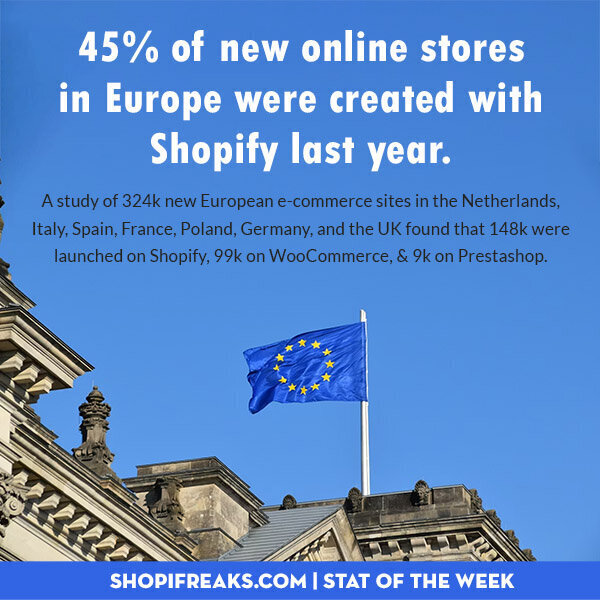
45% of new online stores in seven major European markets were created with Shopify last year, according to a report by ShopRank. The study analyzed 324,000 new European e-commerce sites in the Netherlands, Italy, Spain, France, Poland, Germany, and the UK and found that 148,044 were launched on Shopify, 99,140 were launched on WooCommerce, and 9,747 on Prestashop. |
☁️ TaxCloud - Most U.S. businesses don't realize they can save thousands on sales tax. SST-eligible companies can file for free in 24 states. |
1. Stripe is considering acquiring PayPal, according to Bloomberg
Stripe is exploring a whole or partial acquisition of PayPal, according to Bloomberg sources, who said that the talks are preliminary and might not lead anywhere. Regardless of how close a deal actually is, it's interesting that talks of a PayPal acquisition are even being held.
Could Stripe afford to acquire PayPal without taking on debt?
Stripe recently secured a valuation of $159B via a share tender offer to provide liquidity to employees, with the majority of the funds for the offer being provided by investors including Thrive Capital, Coatue, and a16z.
PayPal, although having experienced an 85% slump in market share over the past few years, still holds a market cap of around $42B.
While Stripe is a private company and doesn't have to report how much cash they have on hand, it's highly unlikely that they're sitting on a $42B cash reserve (or potentially $50B+ if they had to pay a premium over the currently traded stock price) to acquire PayPal. They'd undoubtedly have to tap into their investor network and give away parts of the pie to make the deal happen, take on debt, and/or do a partial stock-for-stock trade with existing institutional PayPal holders.
Why would Stripe even want to acquire PayPal?
Likely for a few reasons:
- PYPL is incredibly undervalued right now on the market. Even if they paid a 20% premium, Stripe would be getting a steal in my opinion.
- PayPal / Venmo have a combined 540M wallet users, while Stripe's Link only has around 200M users, most of which I'm convinced don't have the same relationship with Stripe that they do with PayPal. Meaning consumers choose to pay with PayPal, whereas Stripe Link is just kind of there on some websites with their payment info saved.
- Stripe doesn't currently have a peer-to-peer or in-house BNPL offering, both of which PayPal/Venmo bring to the table.
- PayPal's Braintree is Stripe's direct competitor for enterprise processing, and a merger would effectively consolidate that market.
- PayPal has been positioning itself as the digital wallet of choice for agentic commerce, which Stripe would inherit.
- PayPal is at the beginning stages of growing an ad network, a high margin vertical that Stripe would also inherit, alongside the decades of consumer purchase behavior data that PayPal brings to the table to power that ad network.
- A merger with PayPal could instantly take Stripe public without having to go through the traditional IPO process. Now, would one of the most coveted private companies in the world, that has never expressed urgency or even desire to go public, even want to go public in that manner? I'd think not, as they likely have a lot more to gain through a traditional IPO that would undoubtedly skyrocket their share price, but maybe there are things I'm not aware of that would make a reverse merger attractive.
The list of reasons to acquire PayPal goes on and on, but hopefully that sheds some light on why Stripe could be entertaining the idea.
However I hope that Stripe doesn't acquire PayPal -- both for personal financial reasons and because I don't see it benefiting the market. It would benefit Stripe, but not the market.
First, I'm way too invested in PYPL because I have high aspirations for the company. I don't want cash for my PYPL stock, which I would most likely receive as a retail investor. I want Stripe equity, which there's no way I would get. I don't want a 20% premium on my PYPL either. I want to see the 10+ year upside to PayPal's valuation, which is why I heavily invested in the stock in the first place .
Second, I don't want a payment processing monopoly. I want competition in the market, which Stripe and PayPal currently bring to each other. It's already hard enough for a startup payment processor to compete in the market with either Stripe or PayPal, let alone the combination of the two. It'd also be a loss for merchants, who in many cases, would have nowhere to go if their relationship with Stripe went sour (which it's known to do).
What are your thoughts on a Stripe-PayPal merger? Hit reply and let me know or join the conversation on LinkedIn. |
✨ Seguno - Practical apps exclusively for Shopify brands, from email marketing and popups to discounts and design tools, all made to work seamlessly together. |
2. Shopify Campaigns now integrate with ChatGPT Ads
Shopify started arranging for advertisements to promote its merchants within ChatGPT as part of an expansion of its Shop Campaigns network. The way it works: Shopify purchases ad space on the chatbot to display products from merchants, who in turn only pay when a sale occurs.
What are Shop Campaigns?
If you're unfamiliar, Shop Campaigns is a pay-per-sale advertising channel offered by Shopify that lets merchants set a target customer acquisition cost and daily budget, and then automatically serves ads to Shop App users, within the Shopify Product Network, and optionally on Meta, Google, and Snap. Merchants only pay when a customer actually converts, never exceeding their preset CAC, but if they bid too low, their ads might never display. Basically it's a hands-off way to give Shopify a budget and let it advertise for you within its network and across partner networks.
Back to the story...
Shopify has added ChatGPT as one of its partner networks, so merchants who opt-in to Shop Campaigns can now have their products or brand surface in advertisements within ChatGPT answers. At the moment, given that ChatGPT Ads are still in beta, it's the only direct path to advertising on ChatGPT that I'm aware of for Shopify merchants, or for any small brand on any platform.
The Information notes that Shopify's ad network only accounts for a small portion of the company's $11.6B annual revenue, but that Shopify is trying to expand it. The integration with ChatGPT ads provides some additional incentive for brands to experiment with Shop Campaigns. |
🐟 Go Fish Digital - Specializing in SEO, paid media, & social commerce, we blend AI-powered insights with sharp strategy, agile execution, and a team deeply invested in your results. |
3. More than 1,000 companies are suing the Trump Administration for tariff refunds, and Trump issues new tariffs
FedEx filed a lawsuit in the U.S. Court of International Trade seeking a refund for President Trump's tariffs, many of which were deemed illegal in February by the U.S. Supreme Court. Subsequently, FedEx's customers filed a class action lawsuit against FedEx over import duties on products they said should have entered the United States duty-free.
Yup, it's a legitimate clusterfuck. But wait, there's more!
More than 1,000 U.S. companies have filed lawsuits to recoup what they paid on imports including Dyson, Dollar General, Bausch & Lomb, Brooks Brothers, Sol de Janeiro, L'Oreal, Skechers, and EssilorLuxottica. Of course, let's not forget Costco, Revlon, and Kawasaki either, which kicked off their lawsuits at the end of last year.
Reuters reports that more than $175B in U.S. tariff collections are subject to potential refunds, which is a lot of money up for grabs -- at least for the companies. It's doubtful that refunds will trickle down to consumers, who ultimately got hit with the bill through higher product prices. Not to mention the fact that litigation will likely take years, and at this point the cost of tariffs is permanently baked into goods, whether companies continue to pay future tariffs or not.
Senate Democrats are calling for the government to issue refunds directly to consumers over the course of 180 days and pay interest on the refunded amount, but that's a long shot.
Meanwhile, despite his IEEPA tariffs being deemed illegal by the Supreme Court, President Trump issued new 10% tariffs, this time under Section 122 of the Trade Act of 1974 which allows the President to impose tariffs of up to 15% for up to 150 days to address trade deficits. Later he said he would raise them to 15%. Trade agreements be damned. |
🤖 Napster - Meet Napster Station: The first AI concierge built for noisy, chaotic, real-world spaces. It sees you. It hears you. It handles everything. |
4. New York proposes statewide BNPL lending rules
New York unveiled the nation's first comprehensive regulatory framework for BNPL lenders, stepping in on a state level to fill the regulatory gap that the Consumer Financial Protection Bureau left after their recent retreat from regulating the space.
New York Governor Kathy Hochul said:
"Too many New Yorkers have learned the hard way that some 'Buy Now, Pay Later' products are designed to trip them up with junk fees and overly burdensome fine print instead of helping them build a stable financial future. These new nation-leading regulations ensure that lenders know we have clear disclosures, limits on fees and real oversight so families don't get pushed into a debt spiral while big financial companies cash in."
The new regulation would:
- Require mandatory licensing for all BNPL lenders, with separate permissions for interest-free and interest-bearing loans.
- Set strict fee caps on interest rates, origination charges, and late fees.
- Ban convenience fees, which BNPL lenders impose to make payments by certain methods like check.
- Require multilingual disclosures, so borrowers who don't read English can understand what they're getting themselves into.
- Require that periodic statements be sent for each billing cycle outlining balance due and interest charged.
- Require income-based ability-to-repay assessments, of which the requirements are disclosed to borrowers.
- Impose stronger consumer protections for disputes and data privacy.
- Ban "Social Underwriting," which is where lenders use the creditworthiness of a borrower's social network to determine their own loan eligibility.
What's the status of these new rules?
An initial comment period for the draft rules ends March 5. From there, the rules would need to be published in the State Register for a 60-day formal comment period, which may lead to amendments. If everything goes through, the BNPL Act would become effective 180 days after the regulation is adopted.
If passed, companies already operating as BNPL lenders in New York when the regulations take effect must apply for a license within 45 days and may continue operating under a provisional license until their application is approved or denied. |
⭐ doola - LLC Formation, Bookkeeping, Business Taxes, and E-Commerce Analytics—one platform, one point of contact, zero stress. |
5. Shopify thinks it's immune to agentic commerce
Shopify President Harley Finkelstein told investors on the latest earnings call that "to be clear, LLMs do not bypass Shopify's checkout," and that "the complex back end of commerce will always flow through Shopify."
However I've got to push back on one part of that statement: Is checkout really that complex anymore? It seems that everyone from Visa and Mastercard to PayPal and Stripe (both which partially power Shopify's checkout), are creating agentic checkout experiences.
Actually let me push back on two parts of that statement: LLMs do not bypass Shopify's checkout... for now. What's to stop OpenAI, Google, or any AI-powered commerce platform from inviting Shopify merchants to sync their product catalogs and inventory and managing the checkout experience in-house, just like many other omni-channel platforms?
I sync my Shopify product catalog with Amazon on several stores, which handles the checkout (and is developing agentic commerce capabilities). Why couldn't I sync my Shopify products with ChatGPT, especially if it offered me an incentive to do so?
Finkelstein went on to say:
"If you think about shipping or payments or inventory or analytics, that is really the stuff below the surface that every merchant requires, and that's where Shopify shows up. Just in terms of the monetization of agentic, the focus like any other channel is driving both merchant and then consumer adoption and then ensuring it's done really, really well."
Again, I'm going to challenge that -- and not to hate on Shopify or Harley Finkelstein, but for the sake of presenting the thesis that Shopify's moat around its merchant relationships may not be deep enough to entirely hold back the advancing threat of AI-driven commerce to its business model, especially over the long term.
Shipping, inventory, and analytics... would any merchant say Shopify really shines in those areas? Or does Shopify simply provide a connection to third-party platforms that actually do those things really, really well?
Shopify has first-mover advantage, I'll give them that. But what happens to that advantage when OpenAI begins building those connections directly with the same third-party platforms that currently serve Shopify merchants? Because they will.
None of this is to say that Shopify won't continue to develop its platform's competitive advantages in the area of agentic commerce. It's also yet to be determined how big of a role agentic commerce will even play in consumers' shopping habits, while Shopify continues to add value in other areas that currently carry more weight.
However, I think it's important to realize that once there's a real agentic commerce market, there will be pathways to connect to that market that bypass Shopify. Saying otherwise is short term thinking. |
💡 Ideas Focused - Need help growing your e-commerce store or app? Get a free consultation from Matt -- the creator of this newsletter! |
6. The eBay stalking saga ends 5 years later in settlement
eBay and former executives reached a settlement with journalists Ina and David Steiner just days before a civil trial regarding a 2019 harassment campaign was set to begin. The settlement ends a five-year legal battle where eBay personnel sent live insects and bloody masks to the couple, who run the EcommerceBytes blog, for criticizing the company in their publication. The court dismissed the case without prejudice as the parties are finalizing the undisclosed terms within 60 days.
This is honestly one of the most astonishing, yet under-reported lawsuits to hit our industry.
Huge shoutout to Liz Morton of Value Added Resource for her unmatched coverage of the lawsuit over the past several years.
- Back in 2019, a team of high-level eBay security personnel, led by Director of Global Resiliency Jim Baugh, launched a stalking and harassment campaign against Ina and David Steiner for their critical coverage of eBay. The harassment included sending live insects, bloody pig masks, and funeral wreaths to their home, as well as threatening messages, doxxing, in-person surveillance, and an attempted break-in. Who does that?! A bunch of eBay mall cops who take their job too seriously...
- Seven eBay employees pleaded guilty to the harassment and were sentenced for their roles, including Baugh and six others. eBay signed a deferred prosecution agreement with the DOJ, admitting to six felony offenses and paying a $3M fine, which went to the US Treasury, not the Steiners.
- In 2021, the Steiners filed a civil lawsuit naming the seven criminal defendants plus eBay, ex-CEO Devin Wenig, ex-Communications Chief Steve Wymer, ex-SVP Global Operations Wendy Jones, and security firm Progressive F.O.R.C.E Concepts, alleging the harassment campaign was directed from the top of eBay's executive suite.
- The Steiners settled with five of the lower-level security defendants in exchange for their testimony against the executive defendants. The trial was originally set for January 5, 2026 but was pushed to March 2 after Wenig's attorney claimed last-minute scheduling conflicts.
- Just days before jury selection was set to begin, the parties reached an undisclosed settlement. The case was dismissed without costs and without prejudice, with a 60-day window to reopen if the settlement isn't completed.
Crazy, right?! I hope that the Steiners made bank in their lawsuit, as they deserve it for what they went through. |
7. SBA loans are now exclusively for U.S. Citizens & Nationals
As of March 1, 2026, the Small Business Administration is requiring 100% U.S. Citizen or U.S. National ownership for any business seeking an SBA loan, precluding Green Card holders or partially foreign-owned businesses from the lending program. The news actually broke in early February, but the new requirements just took effect yesterday.
What were the rules before?
- Prior to the current administration rewriting the lending rules in early 2025, the SBA followed a "Majority Rule" that had been in place for decades. Businesses that were at least 51% majority owned by U.S. Citizens or Green Card holders were eligible for SBA loans.
- Then in mid-2025, the Trump Administration changed the rules to require 100% ownership by either U.S. Citizens or Green Card holders.
- In January 2026, a 5% "passive" foreign ownership exception was granted, with Green Card holders still eligible for the other 95%.
- However as of yesterday, only U.S. Citizens and Nationals are permitted to receive SBA loans, with Green Card holders excluded entirely.
If you're unfamiliar with the term "U.S. National," it refers in this context to a person born in an outlying territory of the U.S., such as American Samoa or Swains Island. All U.S. Citizens are technically Nationals, but not all Nationals are Citizens. It's just some weird nuance to immigration law.
Why does this matter to the e-commerce industry?
- In Fiscal Year 2025, the SBA guaranteed a record 85,000 loans totaling $45B.
- Roughly 12,000 of those loans were issued to businesses in the "Retail Trade" sector.
- 7k were issued to the Transportation / Wholesale sector, which includes 3PL providers.
- And around 9,000 loans were approved for Information / Professional startups, which include SaaS, digital marketing, and ad agencies, of which e-commerce businesses represent around 20% of new business applications.
Prior to June 2025, approximately 10-15% of SBA loans historically involved at least some level of Green Card or non-Citizen ownership.
For tens of thousands of entrepreneurs, an SBA loan is their best vehicle to receive growth capital for their business. Now, if they were to receive equity investment in their business from a foreign entity or Green Card holder, it would disqualify them from SBA loans in the future.
Good idea? Bad idea? I'm not qualified to judge this one. I just wanted to report the facts so that you're aware of the changes and how it may impact your ability to obtain an SBA loan in the future. |
8. Meta explores stablecoin payments, but this time not its own coin
Meta is exploring ways to integrate stablecoin payments within its apps and platforms, using third-party dollar-pegged tokens rather than launching its own coin. Sources report that Meta has sent out a Request for Product to third-party issuers and mentioned Stripe as a likely candidate for processing its stablecoin payments.
As you might recall, Meta spent years developing its own stablecoin, initially called Libra and later rebranded to Diem, before abandoning the effort in 2022 following pushback from regulators.
This time, the company doesn't plan to launch its own proprietary stablecoin, but instead offer ways for users and businesses to transact on its platforms using their preferred digital currencies. This is an approach they should've taken to e-commerce and influencer marketing more than a decade ago, which ultimately gave way to the rise of TikTok Shop, but that's a conversation for a different day.
Stablecoins are having their moment. The circulating supply of stablecoins surpassed $300B last year, largely due to support from the Trump Administration, which implemented the first federal framework for stablecoin issuers in July 2025 via the GENIUS Act.
By not becoming a stablecoin issuer, and instead integrating with Stripe and/or other stablecoin payment enablers, Meta gets the benefit of users transacting through stablecoin on their platforms, without having to deal with the regulatory scrutiny that ultimately stalled its previous stablecoin project. |
✨ Seguno - Practical apps exclusively for Shopify brands, from email marketing and popups to discounts and design tools, all made to work seamlessly together. |
9. Other e-commerce news of interest
DoorDash announced that it will cease operations for its Deliveroo and Wolt brands in Qatar, Singapore, Japan, and Uzbekistan to refocus its international strategy on prioritizing markets with a clear path to sustainable scale. The company noted that the withdrawals are not expected to materially impact its financial outlook as it competes with Uber and Prosus in Europe. The move comes after DoorDash spent heavily to build its international presence, acquiring UK-founded Deliveroo for $3.9B last year and eastern Europe-focused Wolt for $8.1B in 2022.
GoImagine, the handmade marketplace founded in 2020 that donated 100% of its profits to children's charities, announced that it is shutting down, citing financial, marketing, and network-effect hurdles facing independent marketplaces as reasons for the closure. The company posted a notice on their site advising users that they will shut down on March 23, 2026 and that access to dashboards and listing exports will end on April 6, 2026. The announcement read, "We took a chance on a new philanthropic marketplace model for makers and artists. While it resonated with a passionate group, we ultimately were unable to reach the scale required for long-term sustainability. We came close, but sadly fell short."
Google is preparing to test new search result formats across Europe to give rival hotel, airline, and restaurant search engines more prominence. The move is part of the company's efforts to avoid an EU fine for allegedly favoring its own services in searches, in violation of the Digital Markets Act. Google's move to avoid the fine sort of reinforces the reason why it was given the fine in the first place.
Google's Circle to Search feature, which allows users to draw a circle around any image or screenshot on their phone and search for results, can now scan and identify multiple objects at the same time. For example, a user can see an outfit they like on Instagram, circle the entire person in the photo, and the tool will attempt to find a match for each item they're wearing, including shoes and accessories. At the same time, Google made it easier to see how those clothes might look on you by bringing its virtual try-on feature directly inside Circle to Search. Outside of shopping, Circle to Search can reason through the relationship between different objects in an image. The updates are coming to Galaxy S26 and Pixel 10 phones first before rolling out to more Android devices.
Klaviyo partnered with Google to connect its customer data to Google's advertising, AI, and messaging, enabling brands to move beyond static campaigns and predefined journeys towards AI-powered shopping and messaging experiences. The partnership is powered by Klaviyo's data platform, which processes 3.4B daily customer interactions across more than 8B profiles, and includes live integrations with Google Ads, BigQuery, and Nano Banana for AI image generation. |
Thanks for being a Shopifreak! If you found this newsletter valuable, please leave a review and forward the newsletter to your friends and colleagues to help us grow. See you next Monday, Matt E. Drecksler |
|
|
|